2026 ARTEMIS SCIENCE NUGGETS
Solar Activity Dependence of the Dayside Lunar Surface Potential in the Terrestrial Magnetotail
by Masahisa Kato
Department of Physics, Faculty of Science Division I
Tokyo University of Science, Tokyo, Japan
Introduction
Since the Moon does not have a dense atmosphere and global magnetic field, leaving its surface directly exposed to the ambient charged particles, including ions and electrons. In addition, photoelectrons, which are emitted from a surface when it is exposed to sunlight, are released from the dayside lunar surface. The electric potential of the lunar surface, which represents how strongly the surface is electrically charged, changes to balance incoming and outgoing charged particles. On the dayside, photoelectrons emitted from the surface are a dominant contributor to these particle flows. As a result, the surface potential is generally positive on the dayside. Solar radiation depends on the solar activity, which varies periodically. Because photoelectron emission is controlled by solar irradiation and plays a key role in determining the dayside surface potential, the surface potential is expected to vary with solar activity. Understanding the electrostatic environment of the Moon is important for future exploration, as surface charging can affect both scientific instruments and human safety.
While previous research has examined surface potential variations in response to solar activity when the Moon is directly exposed to the solar wind (Sternovsky et al., 2008), variations when the Moon is inside the Earth’s magnetotail remain unclear. In this study, we combine downward electron observations from ARTEMIS, spanning a full solar cycle, with modeled upward photoelectron energy distributions to estimate the surface potential.
|
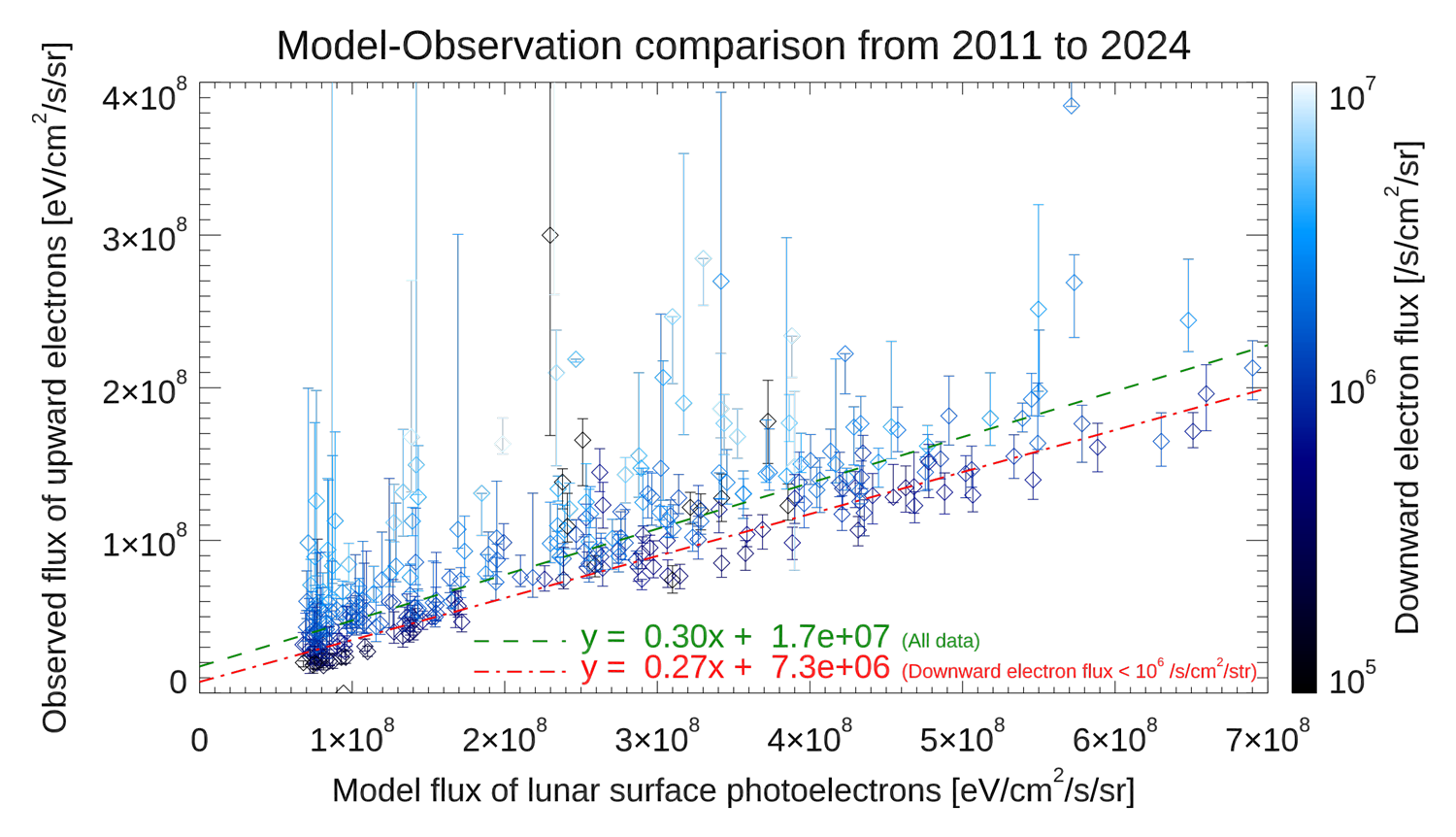
| Figure 1. A comparison between the modeled fluxes (horizontal axis) and observed fluxes (vertical axis) of upward electrons in the energy range from 100 to 600 eV. The color scale indicates the observed downward electron flux integrated from 100 eV to 10 keV. The dashed green and red lines indicate the linear least absolute deviation fitting using all data and using data when the downward electron flux is relatively low (Kato et al., 2026). |
Results
Before estimating the surface charging, we first validated the numerical model (Kato et al., 2023) against actual ARTEMIS measurements. As shown in Figure 1, there is a clear correlation between the modeled photoelectron fluxes and the observed upward electron fluxes across a wide range of solar conditions. This agreement confirms that the model accurately captures how the lunar photoelectron emission responds to changes in solar radiation.
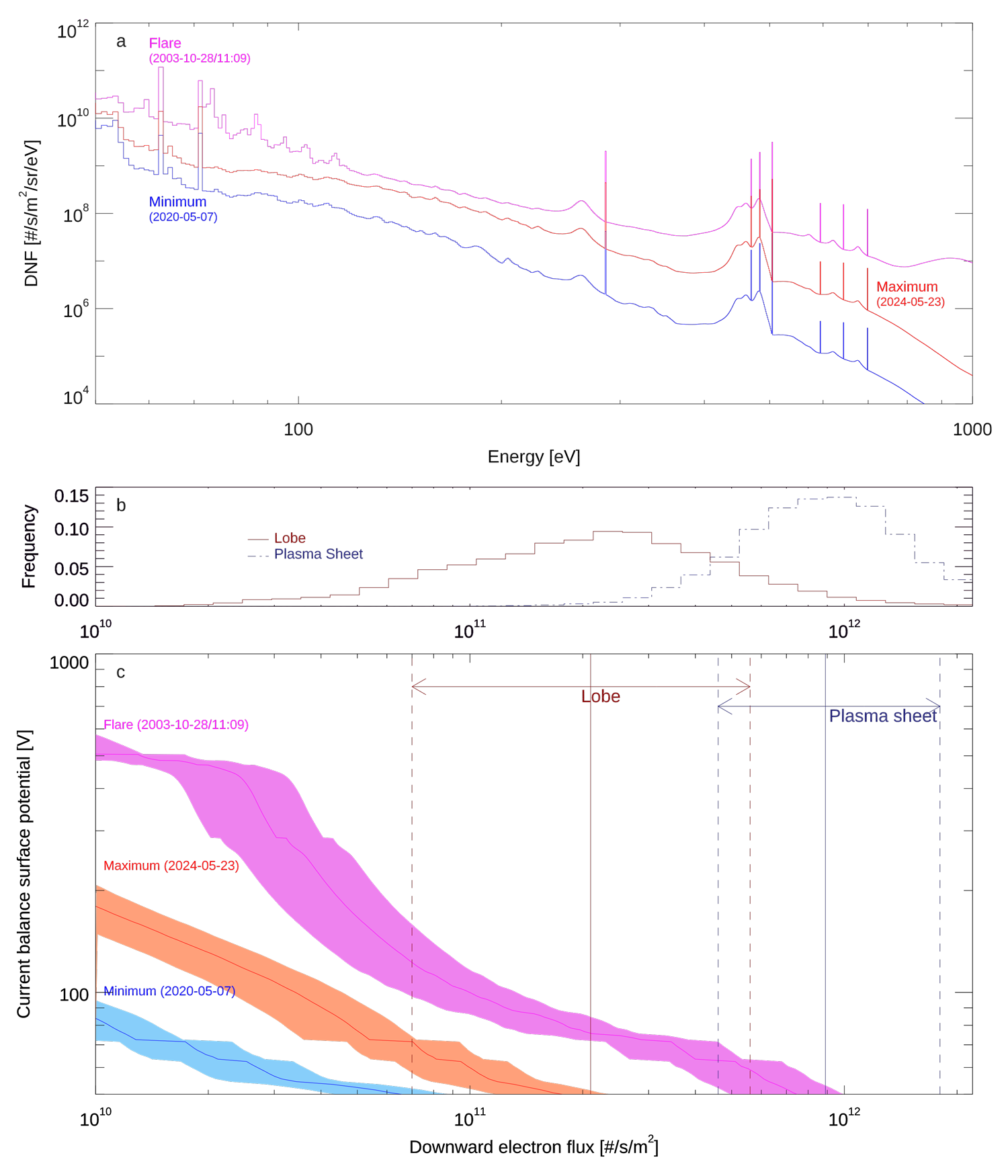
We characterize the typical range of the downward electron flux using actual ARTEMIS measurements, and calculate the 10th percentile, median, and 90th percentile for datasets from two regions: the magnetotail lobes, where the density of charged particles is relatively low, and the plasma sheet, where hot plasma is present (Figure 2b).
Using the validated model, upward electron energy distributions are calculated for three situations: minimum, maximum, and flare, as shown in Figure 2a.
Due to limitations of the numerical model, we cannot estimate surface potentials below +50 V. In the plasma sheet, where the electron flux is higher than in the magnetotail lobes, we can only derive an upper limit of the surface potential under solar flare conditions. In other words, the surface potential in the plasma sheet under extreme conditions can exceed +50 V. Furthermore, the surface potential becomes more positive in the lobes. We also find that it increases with solar activity. During solar flare conditions, the surface potential can exceed +100 V in the tail lobes. While these results are qualitatively consistent with previous studies in the solar wind, the estimated surface potentials are significantly higher than those reported in earlier work.
|
| Figure 2. (a) The estimated electron energy spectra calculated by the model on 7 May 2020 (blue, solar minimum), on 23 May 2024 (red, solar maximum), and at 11:09 UTC on 28 October 2003 (magenta, solar flare event). (b) The histogram of the calculated downward electron flux. (c) The equilibrium lunar surface potential derived from the current balance between downward ambient electrons and upward electrons (Kato et al., 2026). |
Conclusion
We investigated how the photoelectron energy distribution varies with solar activity. By comparing numerically modeled photoelectron energy distributions with over 13 years of ARTEMIS observations, we estimate the dayside lunar surface potential based on the balance between upward and downward currents.
Our findings reveal that extreme solar conditions can dramatically enhance the positive surface potential, especially in the magnetotail lobes, where it may exceed +100 V. Such large surface potentials could pose a hazard for lunar surface exploration. These findings provide a useful reference for assessing electrostatic hazards in future lunar missions.
References
Kato, M., Harada, Y., Xu, S., Poppe, A. R., Halekas, J. S., Miyake, Y., et al. (2023). Modeling photoelectron and auger electron emission from the sunlit lunar surface: A comparison with ARTEMIS observations. Journal of Geophysical Research: Space Physics, 128(10), e2023JA031707.Kato, M., Harada, Y., Xu, S., Poppe, A., Halekas, J. S. (2026). Solar activity dependence of the dayside lunar surface potential in the terrestrial magnetotail. Geophysical Research Letters, 53, e2025GL120581.
Sternovsky, Z., Chamberlin, P., Horanyi, M., Robertson, S., Wang, X. (2008). Variability of the lunar photoelectron sheath and dust mobility due to solar activity. Journal of Geophysical Research, 113(A10).
Biographical Note
Masahisa Kato is a JSPS Research Fellow for Young Scientists (PD) and a Postdoctoral Researcher in the Department of Physics, Faculty of Science Division I, Tokyo University of Science. He received his PhD from the Graduate School of Science, Kyoto University in March 2026. His research focuses on charged particle interactions with the surfaces of airless bodies.
 Please send comments/suggestions to
Emmanuel Masongsong / emasongsong @ igpp.ucla.edu
Please send comments/suggestions to
Emmanuel Masongsong / emasongsong @ igpp.ucla.edu