2026 ARTEMIS SCIENCE NUGGETS
A Galactic Cosmic Ray Cavity in Earth-Moon Space
by Wensai Shang & Quanqi Shi, Institute of Space Sciences, Shandong University
Ji Liu, Department of Physics, University of Alberta
Zigong Xu, California Institute of Technology
Introduction
Galactic cosmic rays (GCRs) are highly energetic particles that originate from violent astrophysical events such as supernova explosions. They travel across vast distances and permeate interplanetary space. Because of their strong penetrating power, GCRs can damage spacecraft electronics and pose significant radiation hazards to astronauts in deep space. At Earth, most GCRs are shielded by the planet’s magnetic field and atmosphere, forming a protective barrier within the magnetosphere. Beyond this region—where Earth’s magnetic influence has traditionally been considered negligible—GCRs have generally been assumed to be approximately uniformly distributed throughout Earth-Moon space. As human activities expand toward the Moon, understanding the radiation environment in Earth-Moon space is increasingly important. Characterizing variations in GCR intensity is therefore essential for the safety and success of future deep-space missions.
|
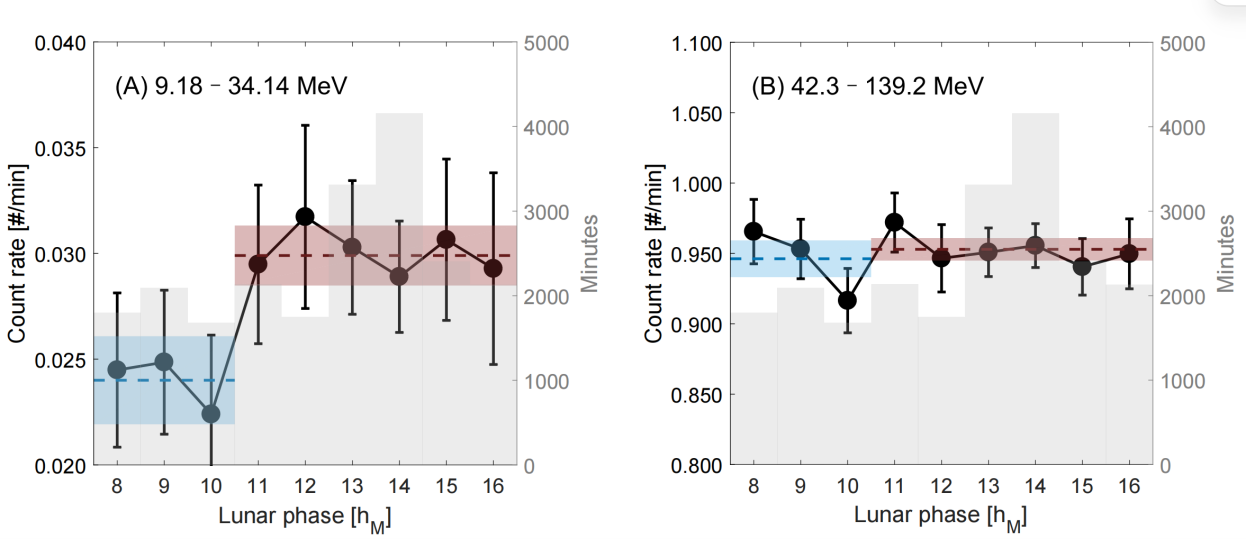
| Figure 1. Variation of the averaged count rate of GCRs along the lunar orbit under stable interplanetary magnetic field and solar wind conditions. (A) Lower energy channel (9.18-34.14 MeV). (B) Higher energy channel (42.3-139.2 MeV). Black dots show the averaged count rate in each 1 hM bin with error bars. The data are grouped into two intervals (8-10 hM and 11-16 hM), with dashed lines indicating the mean values and shaded regions representing ±1σ uncertainties. The lower energy channel shows a clear reduction in count rate in the 8-10 hM interval. Histograms indicate the sampling time in each bin. |
Results
Analysis of data from the Lunar Lander Neutron and Dosimetry (LND) experiment onboard the Chang’E-4 lander reveals a reduction in the GCR count rate in the pre-noon sector of the lunar orbit. Using observations spanning 31 lunar cycles, we find that the GCR count rate decreases noticeably in this region (Figure 1), forming a cavity-like structure in Earth-Moon space. The interplanetary magnetic field (IMF) and solar wind conditions are obtained from ARTEMIS, which provides continuous monitoring of the local plasma and magnetic field environment and enables the selection of appropriate conditions.
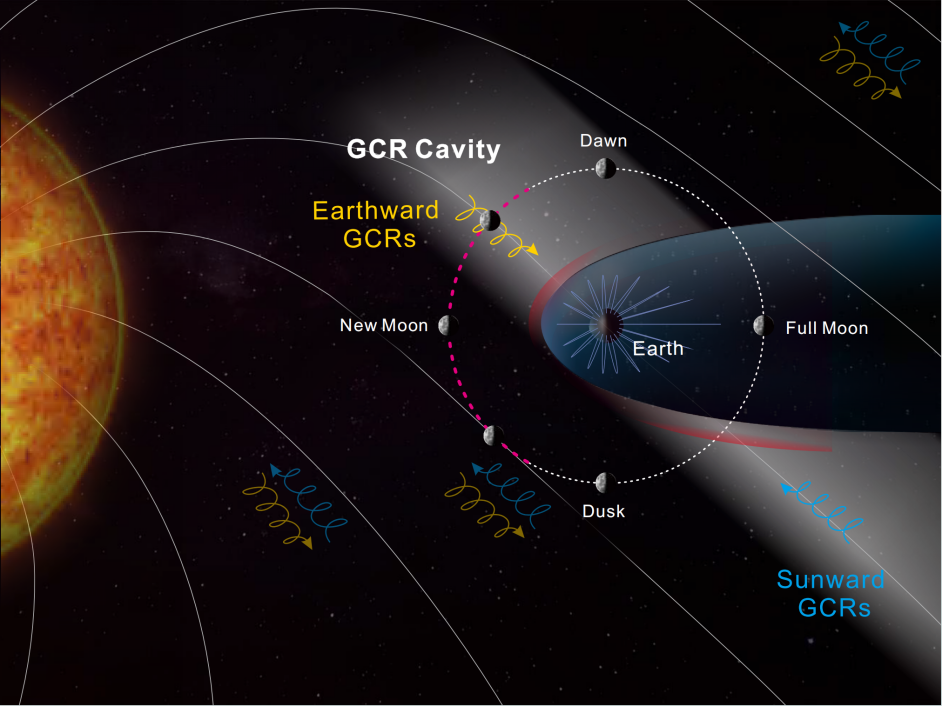
Typically, the IMF in the heliosphere follows the classical Parker spiral. Under this condition, when the Moon is located in the pre-noon sector, the local IMF lines may align such that they connect the Moon to Earth’s strong magnetic field (Figure 2). As a result, GCR particles traveling along these field lines are influenced by Earth’s magnetic field, leading to a reduction in particle flux in this sector. To further verify this pattern, we compare the Chang’E-4/LND results with independent measurements from the Cosmic Ray Telescope for the Effects of Radiation onboard NASA’s Lunar Reconnaissance Orbiter. Both datasets show a consistent reduction in GCR count rate, supporting the existence of the GCR cavity.
|
| Figure 2. Illustration of the formation of the GCR cavity in the ecliptic plane. |
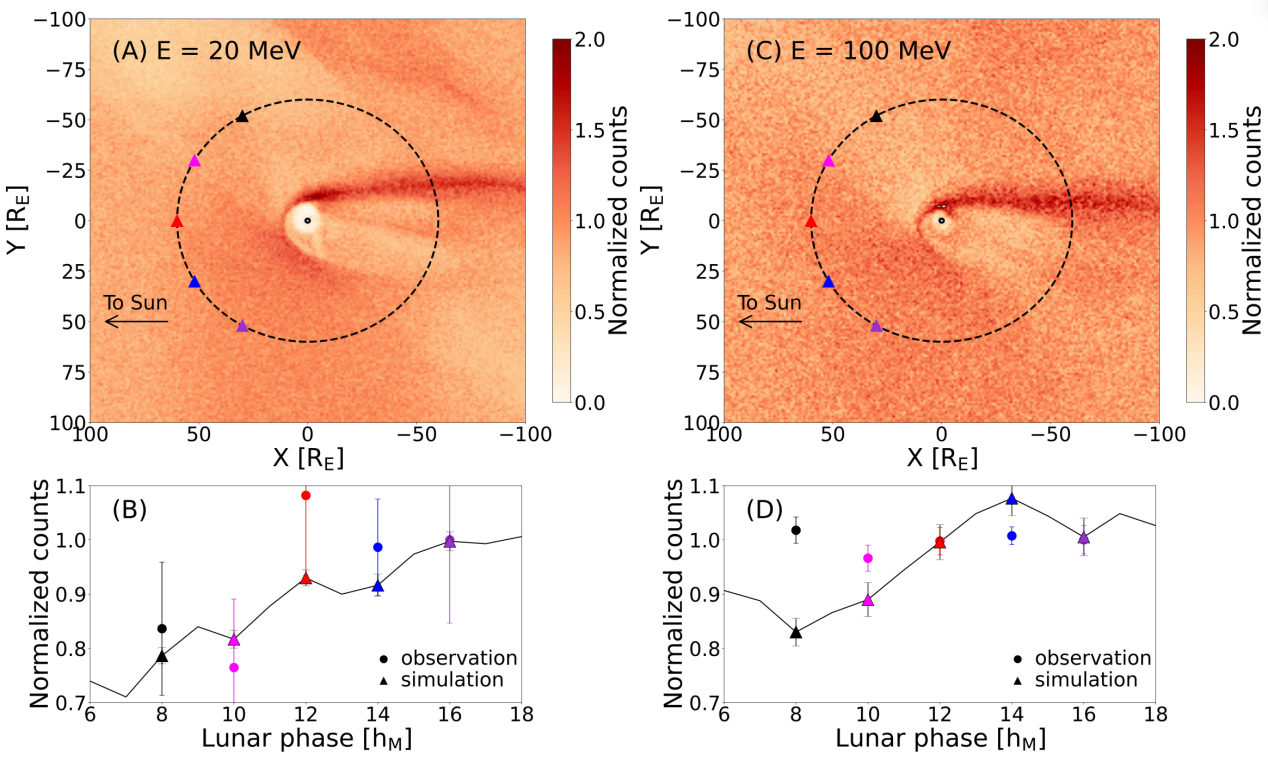
To investigate the underlying mechanism, test-particle simulations are performed, which reproduce the observed reduction along the lunar orbit and show that GCR motion along IMF lines is influenced by Earth’s magnetic field, forming a cavity-like structure (Figure 3).
|
| Figure 3. Simulation results illustrating the impact of Earth’s magnetic field on the spatial distribution of GCRs. Panels A and C depict the simulated normalized GCR count distributions for proton energies of 20 and 100 MeV in Earth-Moon space, respectively. The colorbars represent normalized counts, where the values are normalized to the maximum at lunar phase=16 hM. The arrows indicate the direction toward the Sun. The gray dashed lines represent the lunar orbit, while the black circle outlines the Earth. In panels B and D, the normalized counts from the simulations (triangles) and measurements (circles) along the lunar orbit are plotted as a function of the lunar phase at 8, 10, 12, 14, and 16 hM. This demonstrates the correlation between the simulated and observed reduction in GCR counts during specific lunar phases. |
Conclusion
This work identifies a large-scale GCR cavity in Earth-Moon space, formed by the influence of Earth’s magnetic field on GCR particles traveling along IMF lines. The results show that Earth’s magnetic effect extends much farther than previously recognized, reaching at least to the lunar orbit. Because heavier charged particles are more sensitive to magnetic influences, the shielding effect associated with this cavity may be even stronger for the most hazardous components of space radiation. Similar structures may also exist near other magnetized planets, highlighting the broader role of planetary magnetic fields in shaping radiation environments across the solar system. This finding also has practical implications for future exploration, suggesting opportunities to reduce radiation exposure during lunar and deep-space missions.
References
Shang, W., J. Liu, Z. Xu, C. Yue, R. Guo, C. Xiao, Q. Shi, R. F. Wimmer-Schweingruber, J. Guo, A. W. Degeling, R. Rankin, A. Tian, Q.-G. Zong, C. Han, J.-S. Park, H. Wang, W. Liu, S. Fu, L. M. Zhai, D. Chen, S. Ni, T. L. Chen (2026), A galactic cosmic ray cavity in Earth-Moon space, Sci. Adv., 12, eadv1908.Biographical Note
Dr. Wensai Shang is a postdoctoral fellow in Institute of Space Sciences, Shandong University. His research focuses on the Earth-Moon space environment.
Dr. Ji Liu recently completed his Ph.D. at the University of Alberta. His doctoral research focused on the modeling of ULF waves and their interactions with particles.
Dr. Zigong Xu is a postdoctoral fellow in California Institute of Technology. His research focuses on the acceleration and transport of solar energetic particles and cosmic rays within the heliosphere.
Professor Quanqi Shi is leading an international research group on solar wind-magnetosphere interactions in Institute of Space Sciences, Shandong University. His research widely covers solar wind-magnetosphere-Moon interaction, Earth-Moon space environment, aurora in the Earth and other planets, planetary space environment and beyond. Further information can be found at: https://space.wh.sdu.edu.cn/info/1065/2075.htm
 Please send comments/suggestions to
Emmanuel Masongsong / emasongsong @ igpp.ucla.edu
Please send comments/suggestions to
Emmanuel Masongsong / emasongsong @ igpp.ucla.edu